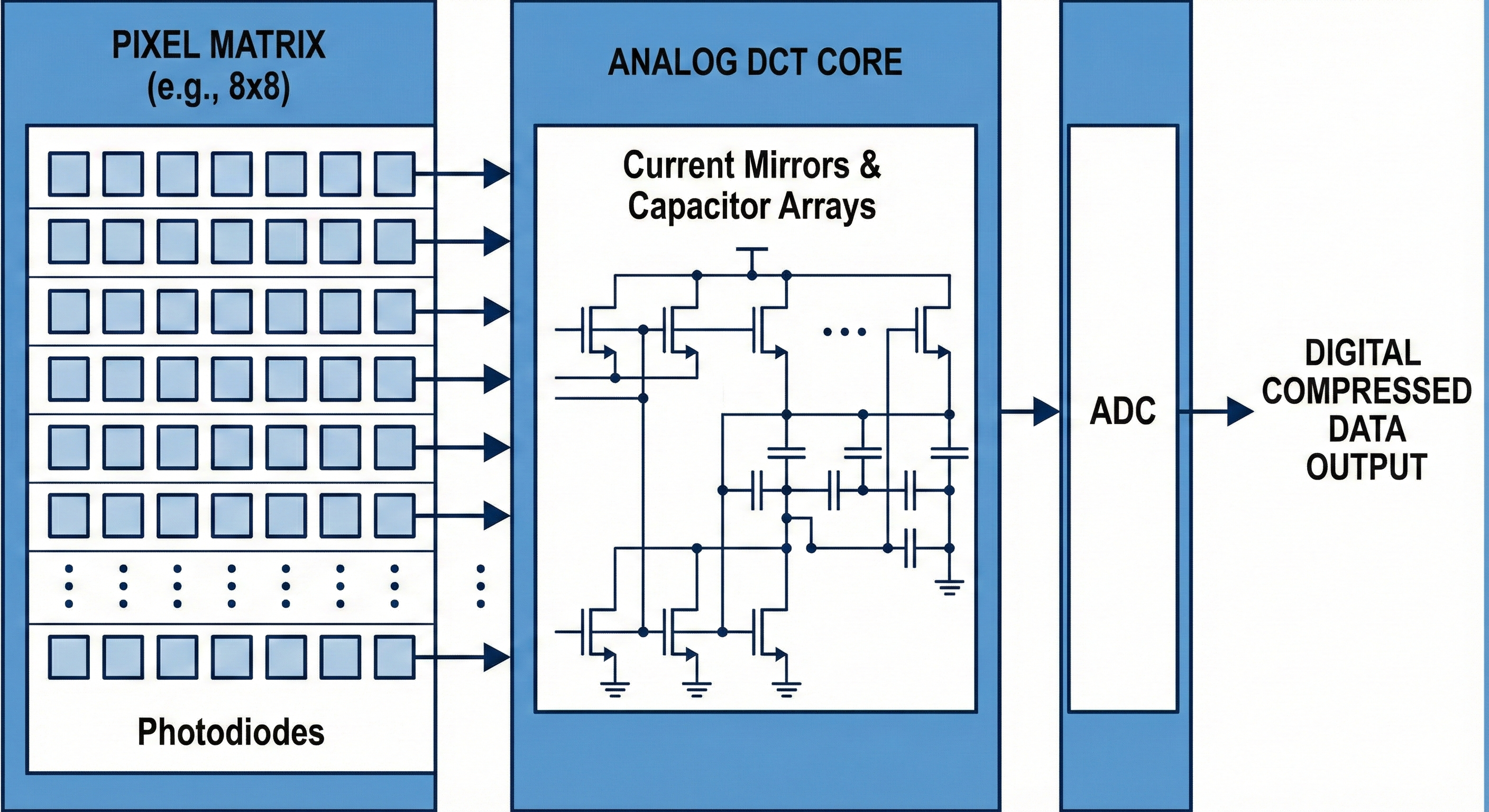
The relentless demand for higher resolution (more pixels) and faster frame rates in modern imaging systems—such as in machine vision, scientific research, and autonomous vehicles—has created a significant data bottleneck. High-speed image sensors, especially those based on CMOS technology, generate massive amounts of raw analog data that must be converted to digital form, transferred, and stored.
This research topic explores Analog Compression Techniques applied directly within the image sensor's front-end, prior to the Analog-to-Digital Converter (ADC). This crucial placement allows for data reduction before the most power-hungry and bandwidth-limiting stage (the ADC and readout circuitry), providing a path toward meeting the extreme performance and efficiency requirements of next-generation imagers.
Key Research Areas and Techniques
The core objective is to reduce data redundancy while minimizing the impact on image quality, all within the strict area and power constraints of a pixel array.
-
In-Pixel and Column-Parallel Processing: Instead of compressing data off-chip, analog techniques are implemented at the pixel level (in-pixel processing) or in the column readout circuitry (column-parallel processing) to take advantage of the high correlation between neighboring pixels (spatial redundancy).
-
Analog Transform Coding: This involves performing transform operations directly in the analog domain before quantization.
-
Discrete Cosine Transform (DCT): Analog implementations of 2D DCT can concentrate image energy into a few coefficients. By digitizing only these significant coefficients, the required number of ADC conversions and data bits is greatly reduced.
-
Wavelet Transform (DWT): Similar to DCT, analog DWT can be used to decompose the image signal, enabling selective quantization and compression.
-
Analog Predictive and Differential Coding: This utilizes the strong correlation between adjacent pixels.
-
Differential Coding: The circuit captures and quantizes the difference between a pixel's value and a reference (often a neighbor or a block average), rather than the absolute pixel value. Since the difference is typically smaller, it requires fewer bits for accurate representation. This is a form of lossy or near-lossless compression.
-
Compressed Sensing (CS) Techniques: CS is an emerging paradigm that leverages the sparsity of natural images to acquire a compressed representation directly at the sensor.
-
In the analog domain, this involves taking fewer linear random measurements of the image scene than dictated by the Nyquist-Shannon sampling theorem. While reconstruction is computationally intensive and usually performed off-chip, the data acquired by the sensor's readout circuitry is significantly reduced, enabling much higher frame rates with a fixed ADC speed.


 Mixed-signal circuits and data converters
  Biomedical circuits and sensor interfaces